
Welcome to this week’s STEMLeap Spotlight! Each edition, we explore groundbreaking advancements in STEM, and today, we’re diving into a discovery that could revolutionize the world of computing—a brand-new state of matter!
A New State of Matter?
You might have learned about the basic states of matter: solid, liquid, gas, and plasma. But what if we told you Microsoft has discovered something entirely new? This isn’t science fiction—it’s the result of cutting-edge research in quantum physics.
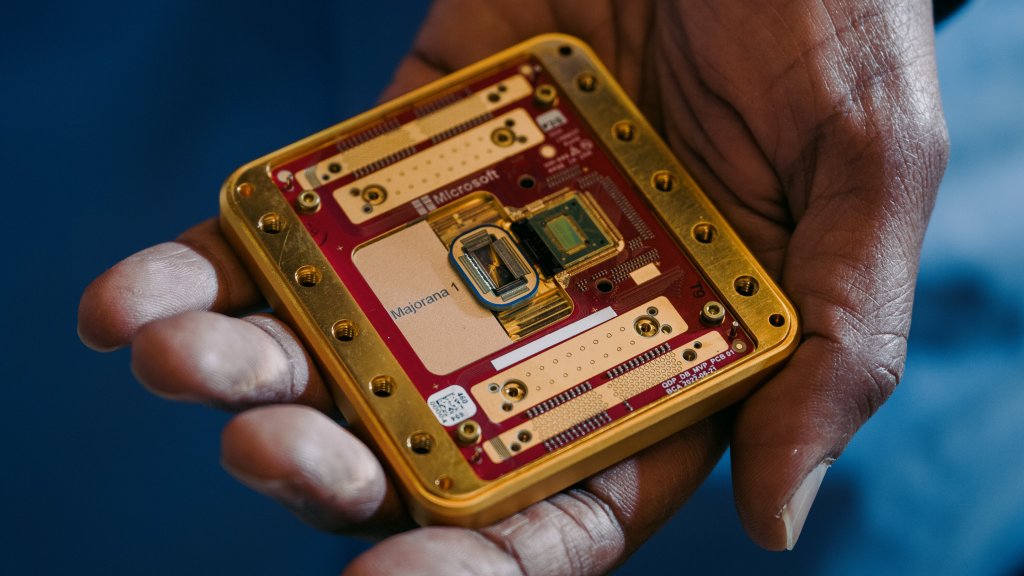
Microsoft researchers have successfully created and stabilized a unique type of particle known as a Majorana zero mode, which behaves in ways never seen before in nature. This particle is the foundation of what they call topological quantum matter, a new state of matter that could transform computing as we know it.
Why Does This Matter?
The world of quantum computing has long struggled with one major issue: quantum instability. Traditional quantum bits (qubits) are incredibly fragile, easily disturbed by their surroundings, making quantum computers difficult to scale. However, Microsoft’s breakthrough could change that.
By harnessing this new state of matter, they have created topological qubits, which are far more stable than regular qubits. These qubits are resistant to external interference, meaning they can store and process information with unprecedented reliability. In short, this discovery brings us closer than ever to practical quantum computers.
How Did They Do It?
Microsoft’s researchers built a specialized quantum processor called Majorana-1, powered by topological qubits. The key to their success was the ability to control and manipulate Majorana particles, something scientists have been trying to achieve for decades. This required working with ultra-cold temperatures and precisely engineered nanowires, where these exotic particles emerge under the right conditions.
The Future of Computing
So, what does this mean for the future? If Microsoft can scale this technology, quantum computers could solve problems that today’s most powerful supercomputers can’t handle. This could lead to breakthroughs in:
- Drug discovery – Simulating complex molecules to design new medicines.
- Cryptography – Creating unbreakable encryption for secure communications.
- Artificial intelligence – Training AI models faster and more efficiently.
- Materials science – Designing new materials with revolutionary properties.
While we’re still in the early days, this discovery represents a major step toward making quantum computing practical and accessible.
Want to Learn More?
Quantum mechanics can be tricky, but here are some great resources to help you dive deeper:
- Quantum Country – A beginner-friendly introduction to quantum computing.
- PBS Space Time (YouTube) – Engaging videos on quantum physics and computing.
- Microsoft’s Quantum Blog – Read more about their latest research here.
The next decade will likely be full of even more quantum breakthroughs. Stay tuned, and who knows? Maybe one day, you’ll be programming a quantum computer yourself!
Daniel Draper, Feb 23
Be sure to check back next week for another edition of STEMLeap Spotlight!
 STEMLeap
Leave a comment